How to use ChatGPT with Solidity
Using the Solidity Scholar and other GPT tips
Welcome your new best friend as a Solidity developer: ChatGPT.
If you're a developer and not using ChatGPT yet, then what the hell are you doing? Let's explore some unique ways this can help you as a Solidity developer.

You can just chat directly with ChatGPT or you can use custom GPTs. I have created the Solidity Scholar which has the full Solidity documentation as database, along with all EIPs/ERCs and the Openzeppelin Contracts. If you want to use it, take a look at https://chat.openai.com/g/g-hzhknMfDH-solidity-scholar.
Using the Solidity Scholar / ChatGPT

1. ELI5 Solidity and Metaphors
A good strategy for understanding and learning new concepts is to ask the AI to explain like I'm 5 and/or ask it to explain it with some metaphors. It will help you understand more complicated concepts. And you can ask follow-up questions.
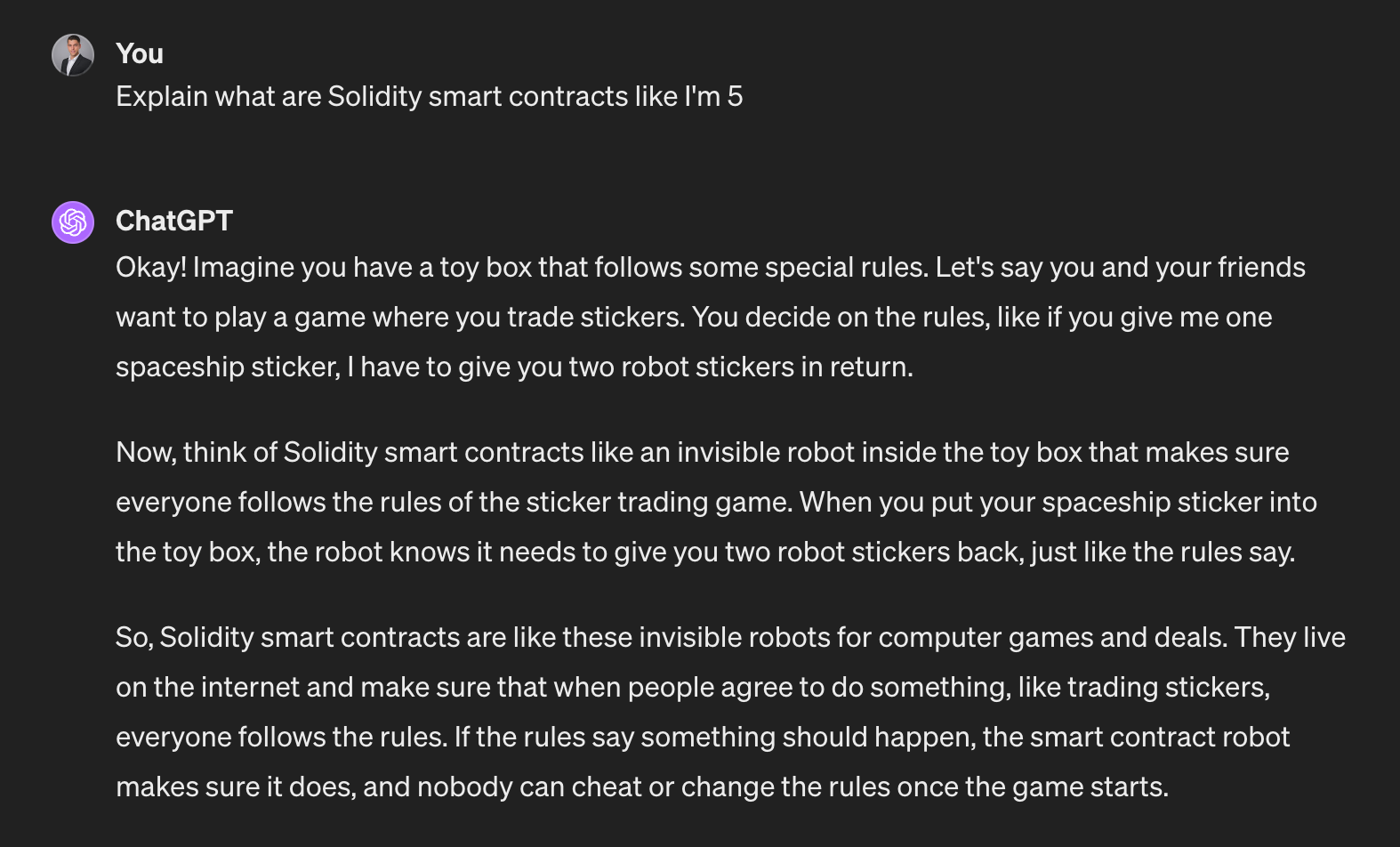

2. Dive into Solidity Details
Once you're familiar with the basics, dive deeper. Ask me about specific Solidity features or syntax, like "Can you explain how smart contract inheritance works in Solidity?"
3. Explore EIPs and ERCs
To understand the evolving standards, ask about specific EIPs or ERCs. For instance, "What is ERC-20 and how is it implemented in Solidity?"
4. Best Practices and Common Patterns
Ask about best practices in Solidity. You might ask, "What are some security best practices when writing Solidity contracts?"
5. Troubleshooting
If you're facing specific issues or need help debugging, feel free to ask. For example, "I'm getting an error when compiling my Solidity contract. What could be the reason?"
6. Code Snippets / Templates
You can also use ChatGPT simply to save time. For example provide an existing ERC20 contract and then ask it to add a 1% transfer fee to it. Or ask it to write full contracts, the more specific your instructions, the better the output will be.
7. Auditing Your Solidity Smart Contracts

One special mention is deserved for auditing Solidity contracts. ChatGPT can be immensely helpful here. In particular if you are using appropriate variable and function names in your Solidity code. You can ask general questions like:
- Do you see any security issues with this code?
- Can you think of exploits for this smart contract?
- Are there bugs in this code?
Or you can be more specific, if you have specific concerns:
- Are there reentrancy attack issues with this contract?
- Could there be a DOS attack for this contract?
- Does the invariance x * y = k always hold?
The more specific the questions, the more likely ChatGPT can find vulnerabilities. Obviously don't rely solely on ChatGPT for audits, it's merely one additional tool in your tool box as Solidity developer.
Solidity Developer
More great blog posts from Markus Waas

How to integrate Uniswap 4 and create custom hooks
Let's dive into Uniswap v4's new features and integration
How to integrate Wormhole in your smart contracts
Entering a New Era of Blockchain Interoperability
Solidity Deep Dive: New Opcode 'Prevrandao'
All you need to know about the latest opcode addition
How Ethereum scales with Arbitrum Nitro and how to use it
A blockchain on a blockchain deep dive
The Ultimate Merkle Tree Guide in Solidity
Everything you need to know about Merkle trees and their future
The New Decentralized The Graph Network
What are the new features and how to use it
zkSync Guide - The future of Ethereum scaling
How the zero-knowledge tech works and how to use it
Exploring the Openzeppelin CrossChain Functionality
What is the new CrossChain support and how can you use it.
Deploying Solidity Contracts in Hedera
What is Hedera and how can you use it.
Hedera is a relatively new chain that exists since a few years, but recently added token service and smart contract capabilities. You can now write and deploy Solidity contracts to it, but it works a little differently than what you might be used to. Let's take a look! What is the Hedera Network?...
Writing ERC-20 Tests in Solidity with Foundry
Blazing fast tests, no more BigNumber.js, only Solidity
ERC-4626: Extending ERC-20 for Interest Management
How the newly finalized standard works and can help you with Defi
Advancing the NFT standard: ERC721-Permit
And how to avoid the two step approve + transferFrom with ERC721-Permit (EIP-4494)
Moonbeam: The EVM of Polkadot
Deploying and onboarding users to Moonbeam or Moonriver
Advanced MultiSwap: How to better arbitrage with Solidity
Making multiple swaps across different decentralized exchanges in a single transaction
Deploying Solidity Smart Contracts to Solana
What is Solana and how can you deploy Solidity smart contracts to it?
Smock 2: The powerful mocking tool for Hardhat
Features of smock v2 and how to use them with examples
How to deploy on Evmos: The first EVM chain on Cosmos
Deploying and onboarding users to Evmos
EIP-2535: A standard for organizing and upgrading a modular smart contract system.
Multi-Facet Proxies for full control over your upgrades
The EIP-2535 standard has several projects already using it, most notably Aavegotchi holding many millions of dollars. What is it and should you use it instead of the commonly used proxy upgrade pattern? What is a diamond? We're not talking about diamond programmer hands here of course. A diamond...

MultiSwap: How to arbitrage with Solidity
Making multiple swaps across different decentralized exchanges in a single transaction
If you want maximum arbitrage performance, you need to swap tokens between exchanges in a single transaction. Or maybe you just want to save gas on certain swaps you perform regularly. Or maybe you have your own custom use case for swapping between decentralized exchanges. And of course maybe you...

The latest tech for scaling your contracts: Optimism
How the blockchain on a blockchain works and how to use it
Have you heard of Optimism? The new Optimistic VM enables Plasma but for smart contracts! What does that mean? Well read on. But what it enables is having a side chain with guarantees of the Ethereum mainnet chain. How cool is that? And you can already use it for several apps on mainnet....

Ultimate Performance: The Aurora Layer2 Network
Deploying and onboarding users to the Aurora Network powered by NEAR Protocol
We've covered several Layer 2 sidechains before: Polygon xDAI Binance Smart Chain But today might be the fastest of them all. On top it's tightly connected to the NEAR protocol ecosystem, a PoS chain with a scalable sharding design. And of course they have a bridge to Ethereum! What is the Aurora...
How to use Binance Smart Chain in your Dapp
Deploying and onboarding users to the Binance Smart Chain (BSC)
Using the new Uniswap v3 in your contracts
What's new in Uniswap v3 and how to integrate Uniswap v3
What's coming in the London Hardfork?
Looking at all the details of the upcoming fork
Welcome to the Matrix of blockchain
How to get alerted *before* getting hacked and prevent it
Defi hacks alone have totaled $285M just since 2019. Let's take the Balancer hack for example. The hack was exploiting the fact that a pool with a deflationary token STA (Statera) was created. The pool accumulated a significant liquidity when it was eventually drained by the hack. Read my post on...

The Ultimate Ethereum Mainnet Deployment Guide
All you need to know to deploy to the Ethereum mainnet
We all love Ethereum, so you've built some great smart contracts. They are tested intensely with unit-tests and on testnets. Now it's finally time to go to mainnet. But this is a tricky business... 1. What exactly is a deployment transaction? First let's quickly discuss what a contract deployment...
SushiSwap Explained!
Looking at the implementation details of SushiSwap
You've probably heard of SushiSwap by now. The Uniswap fork brought new features like staking and governance to the exchange. But how exactly are the contracts behind it working? It's actually not too difficult. Knowing how this works in detail will be a great way to learn about Solidity and...
Solidity Fast Track 2: Continue Learning Solidity Fast
Continuing to learn Solidity fast with the advanced basics
Previously we learned all of the basics in 20 minutes. If you are a complete beginner, start there and then come back here. Now we'll explore some more advanced concepts, but again as fast as possible. 1. Saving money with events We all know gas prices are out of control right now, so it's more...
What's coming in the Berlin Hardfork?
Looking at all the details of the upcoming fork
The Berlin Hardfork is scheduled for April 14th after block 12,224,00. Later to be followed by the London Hardfork in July which will include EIP-1559. So let's take a look at the new changes and what you need to know as a developer. EIP-2929: Increased gas costs for state access EIP-2929 will...
Using 1inch ChiGas tokens to reduce transaction costs
What are gas tokens and example usage for Uniswap v2
Gas prices have been occasionally above 1000 Gwei in the past in peak times. Given an ETH price of over 1000 USD, this can lead to insane real transaction costs. In particular this can be a pain when using onchain DEX's like Uniswap, resulting in hundreds of dollars transaction fees for a single...
Openzeppelin Contracts v4 in Review
Taking a look at the new Openzeppelin v4 Release
The Openzeppelin v4 contracts are now available in Beta and most notably come with Solidity 0.8 support. For older compiler versions, you'll need to stick with the older contract versions. The beta tag means there still might be small breaking changes coming for the final v4 version, but you can...
EIP-3156: Creating a standard for Flash Loans
A new standard for flash loans unifying the interface + wrappers for existing ecosystems
Tornado.cash: A story of anonymity and zk-SNARKs
What is Tornado.cash, how to use it and the future

High Stakes Roulette on Ethereum
Learn by Example: Building a secure High Stakes Roulette
It's always best to learn with examples. So let's build a little online casino on the blockchain. We'll also make it secure enough to allow playing in really high stakes by adding a secure randomness generator. Let's discuss the overall design first. Designing the contract Before we program...

How to implement generalized meta transactions
We'll explore a powerful design for meta transactions based on 0x
Enabling meta transactions inside your contract is a powerful addition. Requiring users to hold ETH to pay for gas has always been and still is one of the biggest user onboarding challenges. Who knows how many more people would be using Ethereum right now if it was just a simple click? But...
Utilizing Bitmaps to dramatically save on Gas
A simple pattern which can save you a lot of money
As you may know the most expensive operation in Ethereum is storing data (SSTORE). So you should always look for ways to reduce the storage requirements. Let's explore a particularly useful one: Bitmaps. How to implement a simple Bitmap Let's assume we want to store 10 boolean values. Usually you...
Using the new Uniswap v2 as oracle in your contracts
How does the Uniswap v2 oracle function and how to integrate with it
We've covered Uniswap previously here. But let's go through the basics first again. What is UniSwap? If you're not familiar with Uniswap yet, it's a fully decentralized protocol for automated liquidity provision on Ethereum. An easier-to-understand description would be that it's a decentralized...
Smock: The powerful mocking tool for Hardhat
Features of smock and how to use them with examples
We’ve covered mocking contracts before, but now there’s an additional great tool available: smock. It simplifies the mocking process greatly and also gives you more testing power. You’ll be able to change the return values for functions as well as changing internal contract storage directly! How...
How to build and use ERC-721 tokens in 2021
An intro for devs to the uniquely identifying token standard and its future
Trustless token management with Set Protocol
How to integrate token sets in your contracts
Exploring the new Solidity 0.8 Release
And how to upgrade your contracts to Solidity 0.8
How to build and use ERC-1155 tokens
An intro to the new standard for having many tokens in one

Leveraging the power of Bitcoins with RSK
Learn how RSK works and how to deploy your smart contracts to it
I'm always interested in what other ways one can use their blockchain and Solidity skills. While many projects are still only in the planning or in testnet status, with Rootstock (RSK) you can transfer mainnet Bitcoins to an EVM sidechain and vice-versa already today. Utilizing the power of the...
Solidity Fast Track: Learn Solidity Fast
'Learn X in Y minutes' this time with X = Solidity 0.7 and Y = 20
You might be familiar with the Learn X in Y minutes. For example you could learn JavaScript in 20 minutes at https://learnxinyminutes.com/docs/javascript/. Unfortunately there is no equivalent for Solidity, but this is about to change. Do you have 20 minutes to learn all of the basics? We even...
Sourcify: The future of a Decentralized Etherscan
Learn how to use the new Sourcify infrastructure today
We all love Etherscan. It's a great tool to interact with contracts, read the source codes or just see the status of your transactions. But unfortunately as great as it is, we should not forget that it's a centralized service. The website could be taken down any day. This kind of defeats the...
Integrating the 0x API into your contracts
How to automatically get the best prices via 0x
How to build and use ERC-777 tokens
An intro to the new upgraded standard for ERC-20 tokens
COMP Governance Explained
How Compound's Decentralized Governance is working under the hood
How to prevent stuck tokens in contracts
And other use cases for the popular EIP-165
Understanding the World of Automated Smart Contract Analyzers
What are the best tools today and how can you use them?
A Long Way To Go: On Gasless Tokens and ERC20-Permit
And how to avoid the two step approve + transferFrom with ERC20-Permit (EIP-2612)!
Smart Contract Testing with Waffle 3
What are the features of Waffle and how to use them.
Waffle has been a relatively recent new testing framework, but has gained a lot of popularity thanks to its simplicity and speed. Is it worth a try? Absolutely. I wouldn't run and immediately convert every project to it, but you might want to consider it for new ones. It's also actively being...
How to use xDai in your Dapp
Deploying and onboarding users to xDai to avoid the high gas costs
Gas costs are exploding again, ETH2.0 is still too far away and people are now looking at layer 2 solutions. Here's a good overview of existing layer 2 projects: https://github.com/Awesome-Layer-2/awesome-layer-2. Today we will take a closer look at xDai as a solution for your Dapp. What are...
Stack Too Deep
Three words of horror
You just have to add one tiny change in your contracts. You think this will take you only a few seconds. And you are right, adding the code took you less than a minute. All happy about your coding speed you enter the compile command. With such a small change, you are confident your code is...
Integrating the new Chainlink contracts
How to use the new price feeder oracles
By now you've probably heard of Chainlink. Maybe you are even participating the current hackathon? In any case adding their new contracts to retrieve price feed data is surprisingly simple. But how does it work? Oracles and decentralization If you're confused about oracles, you're not alone. The...
TheGraph: Fixing the Web3 data querying
Why we need TheGraph and how to use it
Previously we looked at the big picture of Solidity and the create-eth-app which already mentioned TheGraph before. This time we will take a closer look at TheGraph which essentially became part of the standard stack for developing Dapps in the last year. But let's first see how we would do...

Adding Typescript to Truffle and Buidler
How to use TypeChain to utilize the powers of Typescript in your project
Unlike compiled languages, you pretty much have no safeguards when running JavaScript code. You'll only notice errors during runtime and you won't get autocompletion during coding. With Typescript you can get proper typechecking as long as the used library exports its types. Most Ethereum...
Integrating Balancer in your contracts
What is Balancer and how to use it
What is Balancer? Balancer is very similar to Uniswap. If you're not familiar with Uniswap or Balancer yet, they are fully decentralized protocols for automated liquidity provision on Ethereum. An easier-to-understand description would be that they are decentralized exchanges (DEX) relying on...
Navigating the pitfalls of securely interacting with ERC20 tokens
Figuring out how to securely interact might be harder than you think
You would think calling a few functions on an ERC-20 token is the simplest thing to do, right? Unfortunately I have some bad news, it's not. There are several things to consider and some errors are still pretty common. Let's start with the easy ones. Let's take a very common token: ... Now to...
Why you should automatically generate interests from user funds
How to integrate Aave and similar systems in your contracts
If you're writing contracts that use, hold or manage user funds, you might want to consider using those funds for generating free extra income. What's the catch? That's right, it's basically free money and leaving funds unused in a contract is wasting a lot of potential. The way these...
How to use Polygon (Matic) in your Dapp
Deploying and onboarding users to Polygon to avoid the high gas costs
Gas costs are exploding again, ETH2.0 is still too far away and people are now looking at layer 2 solutions. Here's a good overview of existing layer 2 projects: https://github.com/Awesome-Layer-2/awesome-layer-2. Today we will take a closer look at Polygon (previously known as Matic) as a...
Contract factories and clones
How to deploy contracts within contracts as easily and gas-efficient as possible
How to use IPFS in your Dapp?
Using the interplanetary file system in your frontend and contracts
Downsizing contracts to fight the contract size limit
What can you do to prevent your contracts from getting too large?
Using EXTCODEHASH to secure your systems
How to safely integrate anyone's smart contract
Solidity and Truffle Continuous Integration Setup
How to setup Travis or Circle CI for Truffle testing along with useful plugins.
Upcoming Devcon 2021 and other events
The Ethereum Foundation just announced the next Devcon in 2021 in Colombia
The Year of the 20: Creating an ERC20 in 2020
How to use the latest and best tools to create an ERC-20 token contract
How to get a Solidity developer job?
There are many ways to get a Solidity job and it might be easier than you think!
Design Pattern Solidity: Mock contracts for testing
Why you should make fun of your contracts
Kickstart your Dapp frontend development with create-eth-app
An overview on how to use the app and its features
The big picture of Solidity and Blockchain development in 2020
Overview of the most important technologies, services and tools that you need to know
Design Pattern Solidity: Free up unused storage
Why you should clean up after yourself
How to setup Solidity Developer Environment on Windows
What you need to know about developing on Windows
Avoiding out of gas for Truffle tests
How you do not have to worry about gas in tests anymore
Design Pattern Solidity: Stages
How you can design stages in your contract
Web3 1.2.5: Revert reason strings
How to use the new feature
Gaining back control of the internet
How Ocelot is decentralizing cloud computing
Devcon 5 - Review
Impressions from the conference
Devcon 5 - Information, Events, Links, Telegram
What you need to know
Design Pattern Solidity: Off-chain beats on-chain
Why you should do as much as possible off-chain
Design Pattern Solidity: Initialize Contract after Deployment
How to use the Initializable pattern
Consensys Blockchain Jobs Report
What the current blockchain job market looks like
Provable — Randomness Oracle
How the Oraclize random number generator works
Solidity Design Patterns: Multiply before Dividing
Why the correct order matters!
Devcon 5 Applications closing in one week
Devcon 5 Applications closing
Watch out for the Devcon 5 applications. You only have one week left to apply either as Buidler Student Scholarship Press Devcon is by far the biggest and most impressive Ethereum conference in the world. And it's full of developers! I am especially excited about the cool location this year in...

Randomness and the Blockchain
How to achieve secure randomness for Solidity smart contracts?
Update 2023 : Ethereum transitioned to Proof of Stake! If you are interested in the randomness there, you can now use the updated info over at https://soliditydeveloper.com/prevrandao. When we talk about randomness and blockchain, these are really two problems: How to generate randomness in smart...